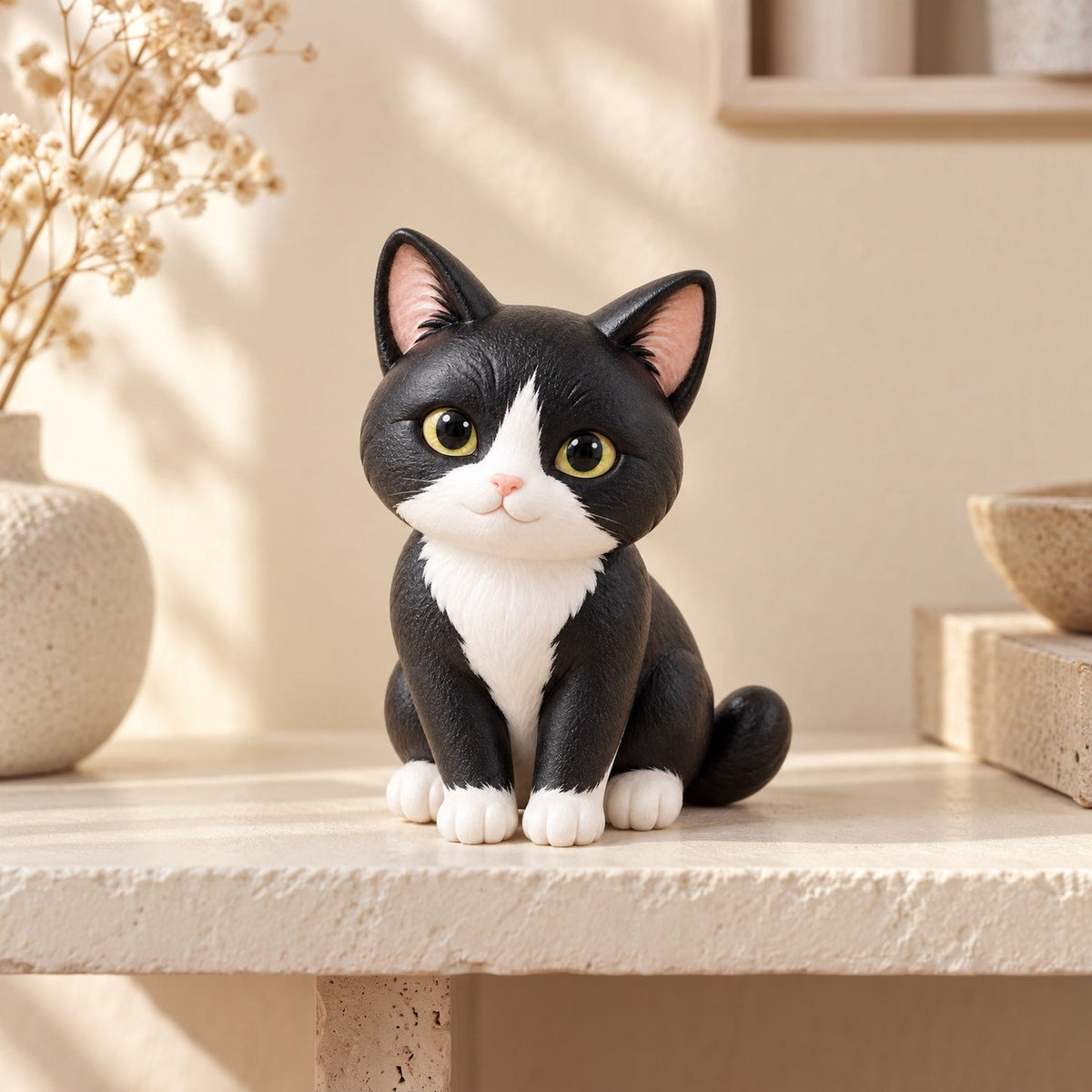
A custom pet figurine is a small thing that carries a lot: their face on your desk, the ear that never quite stood up, the patch you'd know anywhere. Knowing how to choose a custom pet figurine comes down to a handful of decisions you make before you upload a single photo — style, material, size, and how much say you get before anything is made. Get those right and the piece that arrives feels like them. Skip them and you're hoping.
Before writing this, we read a lot of buyer reviews of custom pet figurines, especially the unhappy ones. The complaint that keeps coming back isn't price or shipping. It's some version of "it doesn't look like my dog." Almost everything in this buyer's guide is about avoiding that.
Full disclosure: we make these. PawChibi pieces are chibi-style, printed in solid resin and painted by hand, in two sizes, from $98. We only make chibi, so if you have your heart set on a true-to-life figure, we're not the studio for you, and we'd rather say so now. What we aim for is cute, and recognizably your pet. If you want to see how ours work, here's our custom pet figurine made from your photos. We've written this guide to be useful even if you end up ordering somewhere else.
How to choose a custom pet figurine: the short version
To choose a custom pet figurine, decide the style (true-to-life or stylized) and material, then pick a size for the spot where it will sit. Before you pay, check that the maker asks for front, side and back photos, shows a color preview you can change, says when delivery is counted from, and spells out what a remake covers. There's no single best custom pet figurine, only the one that fits your pet and your shelf. The eight checks:
- Style — a true-to-life portrait, or a stylized chibi.
- Material — painted resin, plush, ceramic or a one-color 3D print.
- Size — decided by where it will actually sit.
- Photos — how many angles the maker asks for, and who looks at them.
- Preview — if you see it, and can change it, before it's made.
- Timing — when the clock actually starts.
- Remakes — what's covered if something goes wrong, and what isn't.
- Price — what's included, not just the number.
1. Style: true-to-life portrait or chibi?
There are two broad directions. A true-to-life figurine tries to shrink your pet down with their real proportions. A stylized piece — chibi, cartoon, bobblehead — changes the proportions on purpose: bigger head, smaller body, simplified fur. Neither is better. The real question is which one you'll be happier living with.
- Want a small portrait you'll study up close? Look for a maker whose gallery is full of true-to-life work, photographed from several angles.
- Want something that makes you smile every time you walk past? A stylized piece usually wins. The likeness lives in the markings, the ear shape, the eye color and the way they hold their head, not in every strand of fur.
- Either way, ask to see finished pieces next to the pet photos they were made from. That pairing tells you more than any product description.
If you're leaning stylized and wondering whether it can still feel like them, we wrote more about what makes a tiny pet look like yours.

2. Material: what it's made of changes what it can show
Each material is good at a different job. A quick comparison:
| Material | Good at | Feel | Best for |
|---|---|---|---|
| Painted resin (3D printed) | crisp shapes and painted markings. | hard and smooth, with some weight if it's printed solid. | a desk or shelf, out of reach of paws. |
| Plush | being hugged. | soft. Markings are translated into fabric and stitching, so fine patterns get simplified. | kids, or anyone who wants to hold it. |
| Ceramic or porcelain | a glazed, classic look. | heavier and glossy. | a display spot where it won't get knocked over. |
| One-color 3D print | shape and silhouette at a lower cost. | a single color, so coat patterns don't show. | pets whose outline says it all. |
How to judge: if the markings matter most — a tuxedo bib, merle patches, the M on a tabby's forehead — you want something painted. If the piece is for a child, soft beats breakable. And if you're looking at resin, ask whether it's printed solid or as a hollow shell; a solid piece has real heft and sits steady.
Ours are printed solid in resin, 10 to 20 hours on the printer for each piece, with no hollow shell and no vent hole underneath. They're display keepsakes, not toys, so they belong somewhere paws and mouths can't reach.

3. Custom pet figurine sizes: start with the spot, not the breed
Most figurines made from pet photos are only a few inches tall, so a custom pet figurine size guide really starts with a ruler. Hold it up at the place where the piece will live — the desk corner, the nightstand, the shelf above the coffee maker — before you pick a size.
Two rough reference points: a piece around 2.5 inches tall is about the length of a house key, and it sits comfortably on a desk corner. A piece around 3 inches is just under the height of a coffee mug. It has more presence across a room and more room for markings and painted detail.
Does the breed decide the size?
Not with a stylized piece. A big dog can still be done small, because chibi proportions are redrawn for whatever size you pick. Breed shape still matters to the design — a Dachshund, a Corgi and a Golden Retriever need very different bodies — but it doesn't decide the size. Clear photos from several angles matter more than going bigger.
Which size is better for a gift?
If you don't know how much room they have, the smaller size is the safer bet. If they have a shelf set aside for it, or the figurine is the main gift, go with the larger one.

4. Photos: how many angles do they ask for?
A figurine is three-dimensional. A single photo shows one side. When a maker works from one picture, someone has to guess at the rest — the tail, the back, where the markings stop — and guessing is the most common reason a finished figurine feels "off."
- Does the maker ask for more than one angle, ideally front, side and back?
- Does a person check your photos before work starts, and tell you if one won't work?
- Is there somewhere to add notes — the ear that's actually up, the collar they really wear?
One thing worth asking any maker: how do you handle a black coat? Black dogs and black cats are the hardest pets to photograph — the camera reads the coat as one flat shape and the face disappears into it. We ask for daylight, no flash, and one close-up of the face taken closer than feels necessary. Then we don't paint them flat black: warm browns and a soft sheen are built up by hand, layer by layer, so the eyes and nose stay readable under a lamp.
For a two-minute walk-through, here's what photos a custom pet figurine needs, angle by angle.
5. Preview: do you see it before it's made?
If you ask only one question before you order, make it this one. Then follow up:
- Is the preview in color, or a plain grey model?
- Can I ask for changes, and does each round add time?
- What happens if I don't reply?
- Will I see anything while it's being made, or is the next thing a tracking number?
A good answer sounds like this: a color preview, a clear way to ask for changes, a written rule for what happens if you go quiet, and at least a photo or two before it ships. If a maker can't tell you what happens when you don't reply, assume the clock keeps running anyway.
6. Timing: ask when the clock starts
"Ships in two weeks" can mean two weeks from the day you order or from the day you approve a design, and it may or may not include time in transit. Revisions and slow replies usually add time on top. For a gift, work backward from the date you want to hand it over, and ask the maker to count it out for you. If you're still deciding what kind of gift to give, our guide to custom pet gifts compares portraits, embroidery, figurines and more.
If it's going straight to them, ask whose email gets the preview and the updates. For a surprise, that should be yours. For a worked example of a full timeline, here's how long a custom pet figurine takes, from photos to doorstep.
7. Remakes: read what's covered before you pay
Custom pieces are made for one pet, so change-of-mind returns generally aren't offered for them. That makes the fine print matter more. Four questions to ask:
- Until when can I cancel for a full refund?
- What if it arrives broken?
- What if it doesn't match the design I approved?
- Is "doesn't look enough like my pet" covered after delivery, or is that what the preview is for?
A fair policy names a clear cancellation point, covers damage in transit and a piece that doesn't match what you approved, and tells you how many days you have to report it. Likeness is usually settled before production, through the preview, which is one more reason the preview matters.
8. Price: compare what's included
Prices for pet figurines made from photos vary a lot. When we checked listings in September 2026, they ran from about $25 for a small one-color print to over $200 for a full-color piece around 3 inches tall, and needle-felted full-body pieces can come close to $500. Material, size, color and how much of the work is done by hand all move the number.
So compare what the price covers, not just the price:
- Is the preview included, and are revisions included?
- Do you see the piece while it's being made?
- Is shipping extra, and is it tracked?
- Is it one pet per piece, and does it arrive ready to give?
We break down how much a custom pet figurine costs with us, including shipping.
If you choose us
PawChibi is a small studio of pet-loving artisans — not a factory — and we take about 50 commissions a month. Every piece is chibi-style and designed from your photos. AI does the first pass on every 3D model; our artisans refine it and do everything after, from sanding and painting to the final check.
- 2.4 in, $98: palm-sized, sits on a desk corner · 3.1 in, $158: just under a coffee mug, with more room for markings and painted detail. One pet per piece.
- Photos: 3–6 from your phone: front, side and back, plus up to three close-ups. A person reviews every set before any modeling begins, and older photos are usually enough.
- Included: design, a color 3D preview, three progress photos of your own piece (off the printer, mid-paint, finished), hand-sanding, hand-painting and our signature pink PawChibi box
- Shipping: $19.99 tracked, per order
- Timing: preview in about 3–5 days; your piece arrives about 4 weeks after you approve it (about 2 weeks of crafting plus about 15 days of tracked shipping). Rush (+$19.99 per order) takes crafting down to about 1 week.
- Peace of mind: full refund any time before you approve your preview; one free remake if it arrives damaged or doesn't match the preview you approved
If you don't reply to your preview, we send one reminder after 3 days and go ahead with the version you last saw 3 days after that, though any reply stops that clock; the PawChibi FAQ and our returns and remakes page cover the rest, including the 14-day window for remakes and why likeness isn't part of one.

Ready when you are: start your custom pet figurine with 3–6 photos. Would they rather carry it than display it? The same pet can be made as a custom pet keychain, same sizes and price, to clip on a bag like a charm.
